
All topics
Farmland: Asset owners, agtech, and ESG

"Buy land, they’re not making it anymore” is a quote often misattributed to Mark Twain.
Despite this misattribution, there is arguably logic in investing in scarcity. After all, space on planet earth is finite.
Given this observation, should allocators consider digging deeper into the merits of owning farmland as an asset class and if so, what sources might inform their decision making?
Asset owners
In Nuveen’s “EQuilibrium Global Institutional Investor Survey”, only 11% of the 800 asset owners surveyed said they planned to invest in farmland investments in the next two years. Moreover, 61% said they are not currently invested in the asset class, nor did they have plans to do so.
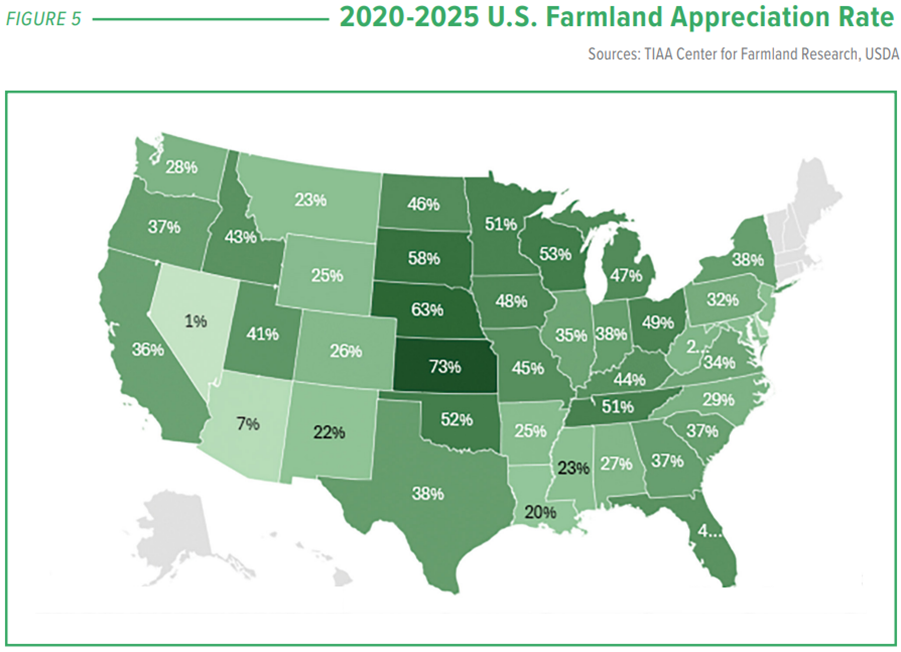
Considering U.S. farmland value appreciation rates in recent years, has the institutional investment community missed out?
Over the period 2020-2025, farmland values have risen strongly across the USA with Kansas, Nebraska, and South Dakota values alone increasing by 73%, 63%, and 58% respectively. See graphic below.
Private wealth
Although Nuveen’s survey indicates that asset owners do not intend to get their hands dirty anytime soon, private wealth sees land ownership, whether for farming or land-banking, as a store of value.
As reported in the “Land Report 100”, Stan Kroenke (famous for ownership stakes in sports assets such as Arsenal football club, the LA Rams, and the Denver Nuggets), now ranks as America’s largest private landowner.
Controlling an estimated 2.7 million acres nationwide, Kroenke is invested in Texas, Wyoming, and Nevada with his “Wildlife Division” focusing on ESG initiatives such as brush management and habitat diversity.
At number 44 out of 100, Bill Gates ranks as the largest private farmland owner in the U.S., sitting on 275,000 acres across 17 states. Gates acquired large swathes in 2017 and 2018 with the Canada Pension Plan Investment Board being one notable vendor to the former Microsoft CEO.
International farmland
Despite the U.S. being an established destination for agricultural investment capital, foreign markets may yield returns for investors willing to look further afield.
In BNP Paribas’ white paper, “Securing Tomorrow’s Harvest: European Farmland as a Strategic Sustainable Investment”, the asset manager tells readers that, “a small but growing number of financial institutions, notably insurance companies and pension funds, have entered the asset class.”
Peoples Company’s report on “International Farmland Markets” further endorses the European opportunity, noting that Spain in particular has, “diverse high-value crops such as citrus, olives, almonds, and subtropicals [which] provide avenues for stable and potentially high returns.”
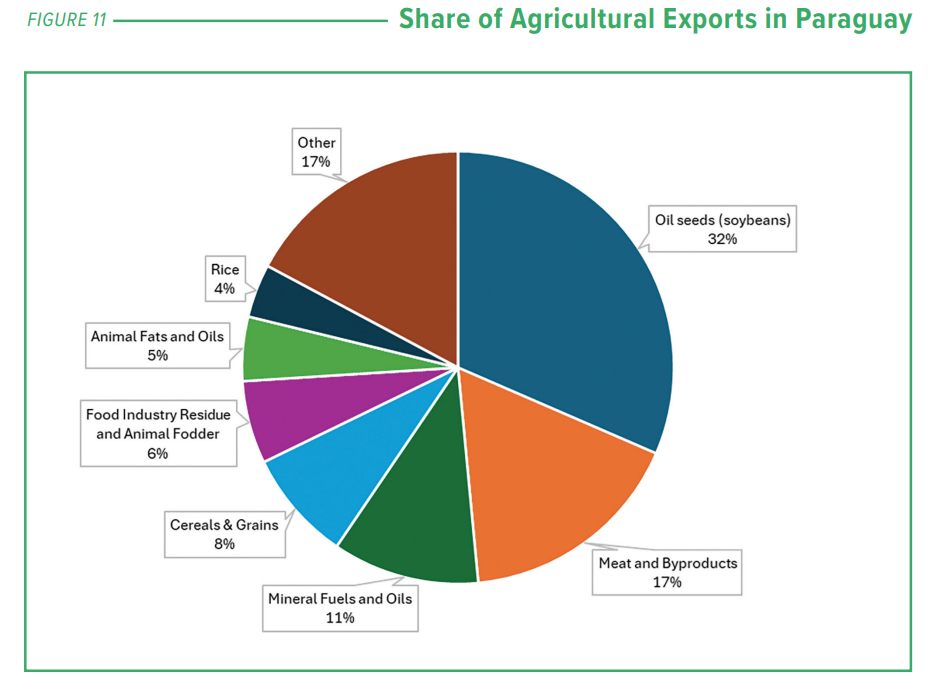
The firm also explains that for investors seeking EM exposure, “Paraguay stands out as an emerging South American market, combining competitive land values, low costs of production and low-cost renewable energy, and expanding export access, particularly in soy and beef.”
Agtech
Should investors view ownership of physical farmland as too much of a ‘plain vanilla’ pod, could there be more exotic opportunities in agricultural technology or agtech?
As reported by Pitchbook, “After several years of decline, VC investment in agtech is enjoying a modest comeback driven by renewed appetite for dual-use tech and advances in robotics.”
Best known for vacuum cleaners and hair dryers, James Dyson of Dyson Farming is a British entrepreneur whose robots neutralise aphids for his strawberries, avoiding the use of chemicals and sprays.
As Dyson emphasises, one can still have, “sustainable nature initiatives in harmony with good farming.”
ESG and glyphosate
Dyson’s combined agtech and ESG philosophy is arguably to be lauded. However, as newly appointed HHS Secretary Robert F. Kennedy Junior may attest, accelerating the transition to regenerative agriculture might not be straightforward.
Referencing RFK’s seemingly incongruous comments on glyphosate use for weed control, the chemical divides opinion for both farmers and conscientious investors.
According to Shelby Bass of AgAmerica, for ESG-focused investors, glyphosate use is, “best evaluated through the lens of long-term land stewardship [via] responsible input management, precision application investments, practices that protect soil health, and transitioning to organic production over time.”
For allocators who are highly ESG-sensitive and may wish to go fully organic, patience is definitely the watchword.
The Rodale Institute’s report on “Organic Farming Economics”, advises that, “before land can be certified organic, farmers must stop applying synthetic fertilizers, pesticides, and other prohibited materials for three years.”

Iran and fertilizer
For conventional farmers who rely on fertilizers, supply disruption in Iran’s Strait of Hormuz has been top of mind for investors lately.
However, recent research from Ken Foster and Bernhard Dalheimer of Purdue University’s Center for Commercial Agriculture, may allay fears somewhat.
In their piece, “The Iran Conflict, Energy Prices, and U.S. Farm Profitability”, they note that, “farmers who pre-purchased or contracted fertilizer before the conflict are largely protected for the 2026 growing season.”
Moreover, the authors advise that, “a short conflict resolved in weeks is likely a manageable cost squeeze, [whereas] a prolonged Strait closure would eventually push grain prices high enough to partially offset margins.”
Final thoughts
The popularity of the Amazon Prime series Clarkson's Farm, which will soon air its fifth season, proves that viewers not only enjoy agricultural entertainment, but also wish to better understand how food travels from farm to fork.
In economics 101, land, labour, and capital are considered the core factors of production. And yet, unlike labour which is readily accessible, and capital, which can effectively be printed, land will always be scarce.
Revisiting our aforementioned misquoted Twainism, and an ever-expanding money supply through credit creation, investors may wish to remind themselves that quite simply:
“You can’t print land.”
To read more about investing in farmland from professional bodies, think tanks, and asset managers, register here at Savvy Investor.
RELATED CONTENT

El Niño and Iran War Reshape Agricultural Commodities (WisdomTree in Europe)
| 09 Oct 2026The National Oceanic and Atmospheric Administration’s (NOAA) Climate Prediction Centre maintained an El Niño Advisory and stated that El Niño is…

Could 'Super El Niño' Scorch AI Too? (Man Group)
| 07 Oct 2026Markets may chronically underprice climate volatility as a systematic risk.

Ford Foundation: Doing Good Is Not the Trade-Off (Swimming with Allocators)
| 06 Oct 2026Roy Swan of the Ford Foundation returns to discuss how impact investing can simultaneously “do good and make money,” unpacking the foundation’s $1…

Enabling Investor Action on Nature through Public Policy (UN PRI)
| 06 Oct 2026Policy briefing outlining the nature‑related risks and opportunities facing investors, with policy recommendations to enable responsible investment…

Glyphosate: An Investor Briefing (ShareAction)
| 06 Oct 2026This report explains how glyphosate is used, what risks it may generate for investments, and how to engage with companies and policymakers to support…